Jeevan Chaudhary
Station ElevenJeevan Chaudhary is a former would-be paramedic whose response to Arthur Leander’s collapse at the Elgin Theatre places him at the threshold of the Georgia Flu pandemic. A warning from his friend Hua turns that night into the beginning of a new life: Jeevan prepares for the outbreak, survives the collapse with his brother Frank, and eventually finds a home in McKinley. By Year Fifteen, the man who once tried to revive an actor in a theatre is the closest thing to a doctor for a wide rural area, living with his wife Daria and their children.
Identity and First Response
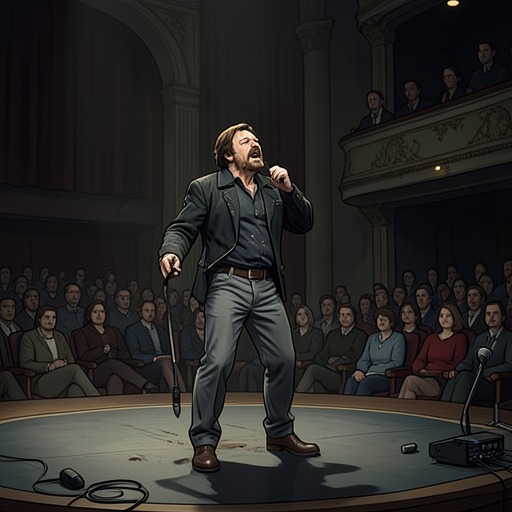
Jeevan is still training to be a paramedic when Arthur collapses during a performance of King Lear. At first, he is unsure whether the actor is still performing, and the audience around him murmurs for him to sit down. But Arthur has stumbled, struck a column, and begun speaking the wrong lines in a failing voice. Jeevan rises from the front row and moves toward him despite his uncertainty and the usher’s approach. The act is not presented as a practiced professional intervention; it begins as a decision made amid confusion, before he knows what is happening.
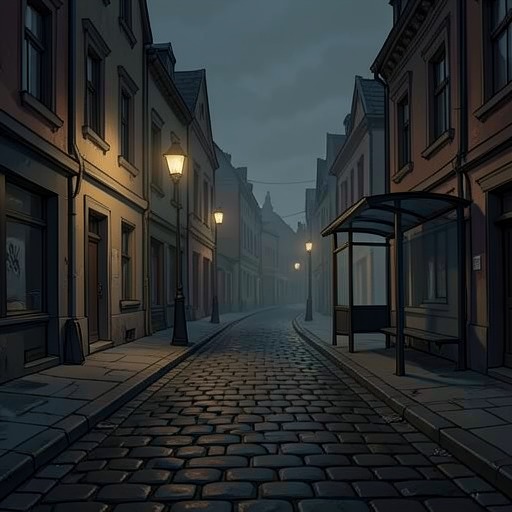
Afterward, Jeevan leaves the theatre alone. His girlfriend has not answered his calls, and he pretends to receive an important call rather than explain what he witnessed. Walking up Yonge Street through the snow, he feels guiltily alive while thinking of Arthur lying still. The contrast stays with him: his own heart is pumping, while his hands ache from trying to compress Arthur’s. Memories of the theatre return in fragments, including Arthur’s last broken words and the child actor Kirsten Raymonde, but the walk also carries him into the immediate crisis beyond the stage.
The Warning and the Collapse
Hua, a friend Jeevan regards as his closest despite their infrequent contact, calls from Toronto General Hospital. They had known one another since working together in a bar after university: Hua went on to medical school, while Jeevan tried to establish himself as a wedding photographer and later photographed actors in Los Angeles. Now Hua tells him that the hospital has admitted more than two hundred flu patients since morning, including fifteen deaths, and that the emergency department is full, with beds in the hallways. Jeevan recognizes that Hua is afraid, not merely tired.
Jeevan leaves the streetcar after considering the passengers around him and wondering whether any came from the airport. When Hua calls again near Frank’s building, he tells Jeevan to leave the city or, if that is impossible, stock up on food and remain indoors. Hua’s warning carries particular force because Jeevan knows him to be understated; if Hua calls it an epidemic, Jeevan understands that the word may not capture its scale. He experiences the warning as a divide between life before and life after. At a grocery store, a television reports that Toronto General and two other hospitals are under isolation and that Health Canada has confirmed an outbreak of the Georgia Flu. Public assurances to remain calm sit beside the hospital closures and reports of fatalities.
Jeevan cannot bring himself to speak to his girlfriend, whose phone remains off, and he goes instead to Frank. In the following days the brothers live by the low-volume television news, whose accumulating death toll seems almost unreal. Jeevan seals the apartment’s air ducts with plastic, hangs Frank’s bath towels over the windows to hide light at night, and moves a dresser in front of the door. When people knock, they stay silent; twice, someone tries to force the lock, but the deadbolt holds. His preparations cannot restore public safety or make the threat fully knowable. They are practical measures against an emergency in which even the route by which infection might reach them remains uncertain.
A New Community and a New Kind of Care
By Year Fifteen, Jeevan has walked a thousand miles from the life he knew. In Year Three he reached McKinley, a settlement founded by eight members of a stranded marketing team. What began as a refuge in an abandoned motel became a lasting community; by the time Jeevan is living there, twenty-seven families are settled across the road from a river. He married Daria, one of the founders, in Year Ten. The scale of his life has changed from city streets and an isolated apartment to the routines and mutual dependence of a small settlement.
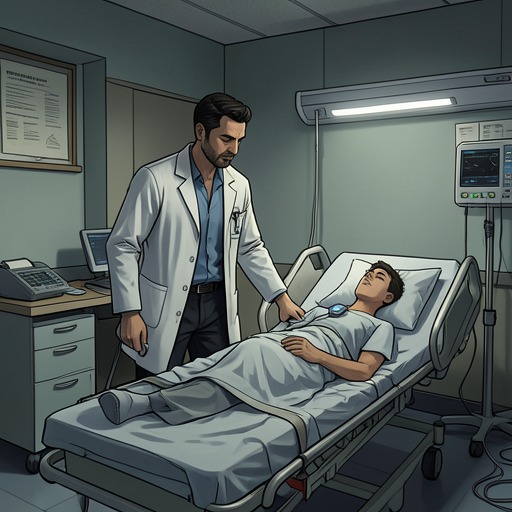
Jeevan has become the closest thing to a doctor within a hundred-mile radius. After a neighbour falls from a ladder, he sets the man’s broken arm. He values being someone others can turn to, though the physical suffering involved in treating injuries without modern anesthesia leaves him shaken. His work is not a return to the formal medical system that failed under the pandemic; it is a local responsibility undertaken with limited means. The contrast between his early training and this later role is important: he has not become a distant expert but a neighbour whose skills matter because someone nearby needs help.
That responsibility becomes urgent when a man arrives on horseback carrying his wounded wife, who has been shot. Jeevan brings her into the motel room used as his surgery and treats her while her husband remains beside her. Afterward, he cleans the needle, carries it to the river to wash it, and boils it in a saucepan on a makeshift oven. The routine of sterilizing equipment follows the work itself, linking care to repeated, practical tasks. As he waits, he thinks about the people who shot the woman and left her on the roadside, and about the Prophet’s threat to move north from the old plantation. The possibility that the Prophet’s followers might reach McKinley makes the distant violence feel relevant to the settlement’s safety.
Family, Memory, and the Later Life
The life Jeevan has made is not defined solely by emergency. One evening by the river, after a difficult day treating the neighbour’s broken arm, he sits with Daria and a friend. He is grateful for the settlement, for his wife, and for having lived to see a time worth living in. He squeezes Daria’s hand. The gesture belongs to a quieter aftermath than the precautions at Frank’s apartment: survival has become not only the avoidance of danger but the presence of companionship and an ordinary place to return to.
In a later glimpse, a thousand miles south of the airport, Jeevan bakes bread in an outdoor oven made from an oil drum. He rarely thinks about his former life, though he sometimes dreams of an actor falling in theatrical snow and of pushing shopping carts through blizzards. The images preserve the beginning of his story as fragments rather than a continuous recollection. His young son, whom he calls Frank, plays near his feet with a puppy while Daria rests indoors with their baby. Jeevan plans to retrieve preserved meat from the river, make sandwiches for the family, and share bread with neighbours. These small provisions—bread, stored meat, a meal offered outward—show how his life has settled into work that sustains both family and community.
Jeevan’s trajectory connects the novel’s opening act of public rescue to its later, less visible forms of care. At the theatre, he answers an emergency before he is sure what he is seeing; during the outbreak, he takes Hua’s warning seriously and turns fear into preparations with Frank; in McKinley, he treats injuries and lives within a community whose survival depends on such acts. His memories do not disappear, but the final glimpse of him places them alongside a family, a warm domestic routine, and a future shaped by the people around him.